
RDJ, Sasquatch, and the Terminator walk into a blog.
Or, “What’s the one thing we could never do?”
Writers Room: Confidential · Vol. 1 · By Chris Adams
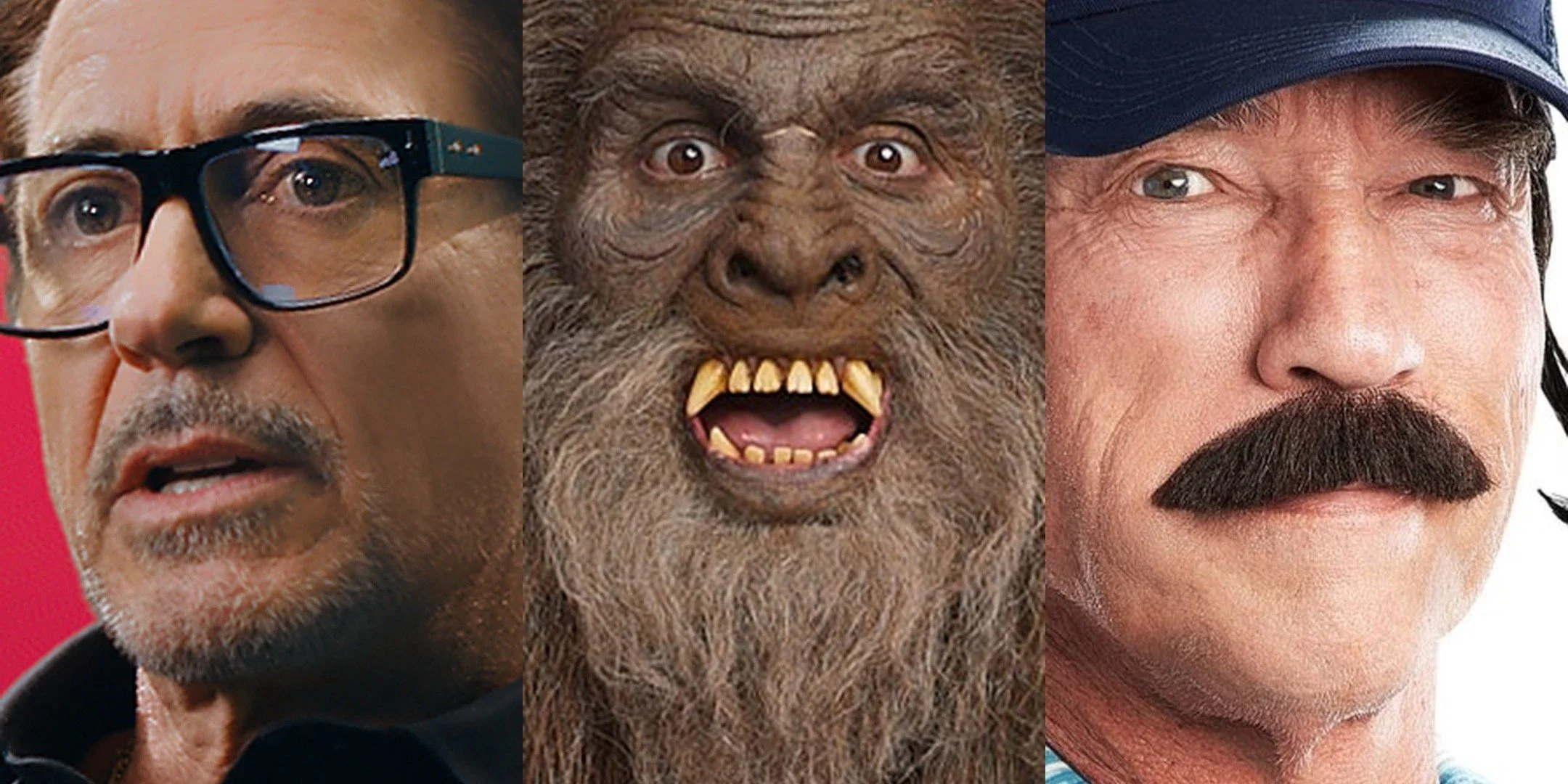
Sometimes in advertising, we get too smart for our own good. We have reams of research. We know the consumer inside and out. We know which product features will resonate, what media to use, and how often to use it. All we have to do is say the right thing in the right channel at the right time, and we’ll be successful. Right?
Well, maybe.
If we don’t push ourselves to find an unexpected, entertaining way to say it, we are missing a huge opportunity. The right message in the right place still has to break through. And the work that breaks through is almost never the work everyone saw coming.
That’s why, in our Writers Room, we often stop and ask one question:
What’s the one thing we could never do?
It’s a simple way to force counterintuitive thinking. To get to big ideas that drive even bigger results. And to get to the kind of work everyone on the team is inspired to champion, from concept all the way through production. It’s also a question we learned how to answer from our friends in Hollywood.
Kill the villain in the first act
Much of what makes Superconductor different is that we try to marry the best of an advertising agency with the best of Hollywood: how the best writers rooms break a story, and how the best production teams go out and make it. So we pay attention when great screenwriters talk about how they solved an impossible problem. And few problems were more impossible than writing Avengers: Endgame, the film our co-founders Joe and Anthony Russo directed.
Writers Christopher Markus and Stephen McFeely had to write one of the most anticipated films of all time, and everyone already knew how it would end. The Avengers would defeat Thanos. The only question was how. They were stuck for weeks. Thanos had the ultimate weapon. He’d see anything coming. Then, as the writers have told it, executive producer Trinh Tran asked the simple question nobody had thought of yet: why not just kill him?
So they did. About fifteen minutes into the film, the villain everyone came to see defeated is gone. Unceremoniously. With no epic final battle. And suddenly, no one in the audience knew what would happen next. That one choice unlocked everything that followed: a five-year jump, a time heist, and a way to revisit the greatest moments in the Marvel films from a completely new point of view.
By doing the one thing they could never do, the writers wrote their way out of the movie everyone expected and into the highest-grossing film of all time.
Make your celebrity ambassador an anti-ambassador
Advertising has its own version of that problem. One of our favorite examples comes from our work for Veloz and the Electric For All campaign. If you have Arnold Schwarzenegger lined up as your brand ambassador, ready to tell Californians all the great reasons to buy an electric vehicle, that’s a pretty great recipe for success, right?
Yes, obviously.
But what’s the one thing we could never do?
We could never have him be against EVs instead. Or could we? Whenever we uncover a big counterintuitive idea, we have a trick that can turn the impossible into the plausible. We ask one simple question.
What would have to be true for us to pull it off?
In this case, the answer was simple: If Arnold couldn’t be the one making the case for EVs, he’d have to be the foil and provoke customers into making the case for them. If he played a salesman pushing gas cars, real shoppers would push back, and they’d make the argument for going electric themselves, in their own words. That’s far more persuasive than any celebrity reading a script.
Once that was true, everything else followed. A prank format. A used car lot. A smog-spewing SUV Arnold couldn’t stop praising. Gas-car arguments so ridiculous that every one became a reason to choose an EV. And as many Arnold catch-phrases as we could think of. We even titled it like an action movie and promoted it like one.
And because it entertained instead of lectured, it persuaded. Kicking Gas earned 11 million organic views, sent 73,000 shoppers to automakers’ websites, and was named a Webby Honoree. See the full campaign and its results.
Launch a brand at the Super Bowl with no media budget.
The question works on budgets, too. When Robert Downey Jr.’s Happy Coffee came to us, it had a great product, a famous founder, and no media budget. And to complicate matters, it was Super Bowl season, when many brands spend eight figures on media to grab attention on the biggest advertising day of the year. So there would be intense competition.
The one thing a brand with no money could never do? A Super Bowl spot.
So, what would have to be true? It would have to be social first. And instead of speaking to Robert’s fans, it would have to make them part of the entertainment. So we didn’t fight over Sunday. We owned the Monday after, the day nobody wants to go to work and everybody needs coffee. A week before the game, Robert asked fans to post their best excuses for skipping work using #HappyMonday. Thousands of excuses poured in. We picked the three best, and on Monday morning Robert joined Zoom calls with each fan and their boss to plead their case for a day off.
Directed by Joe Russo, the calls became a social series built for Robert’s massive following. It drove more than 35 million organic views and won a Webby People’s Voice Award. See the campaign.
Go big outdoors with a nonprofit budget
It works on media, too. For Electric For All’s Don’t Believe the Myths campaign, we wanted the scale of outdoor spectaculars: giant, unmissable images in the busiest places in California. But a pragmatic nonprofit budget doesn’t buy spectaculars.
The one thing we could never do? Outdoor spectaculars.
What would have to be true? We’d need spectacular scale without paying spectacular rates. So we went guerrilla. We projected our mythical creatures, from Sasquatch to the tooth fairy, onto wallscapes in San Francisco, Sacramento, Los Angeles and San Diego. Then we photographed them and shared the photography on social, where the images reached far more people than the walls ever could. The net effect was a campaign that made an outsized impact online and in the real world, driving 1.1 million website visits, three times its benchmark. See the campaign.
Write yourself into a corner
Once you’ve committed to the one thing you could never do, “what would have to be true?” forces you to reverse-engineer a way out. And the way out is almost always more surprising, more entertaining, and more effective than anything you’d have found by playing it safe. It won’t always lead to the right answer. Sometimes the one thing you could never do is something you really shouldn’t do. But it’s a question that’s always worth asking.
— Chris Adams, Co-founder & Chief Creative Officer
Writers Room: Confidential is about how we develop ideas at Superconductor, an award-winning independent ad agency in Los Angeles. Want the next volume in your inbox? Sign up below. Got a problem that needs a different answer? Let’s talk.
Sign up for blog and newsletter updates.
(We’ll only send you good stuff—promise.)